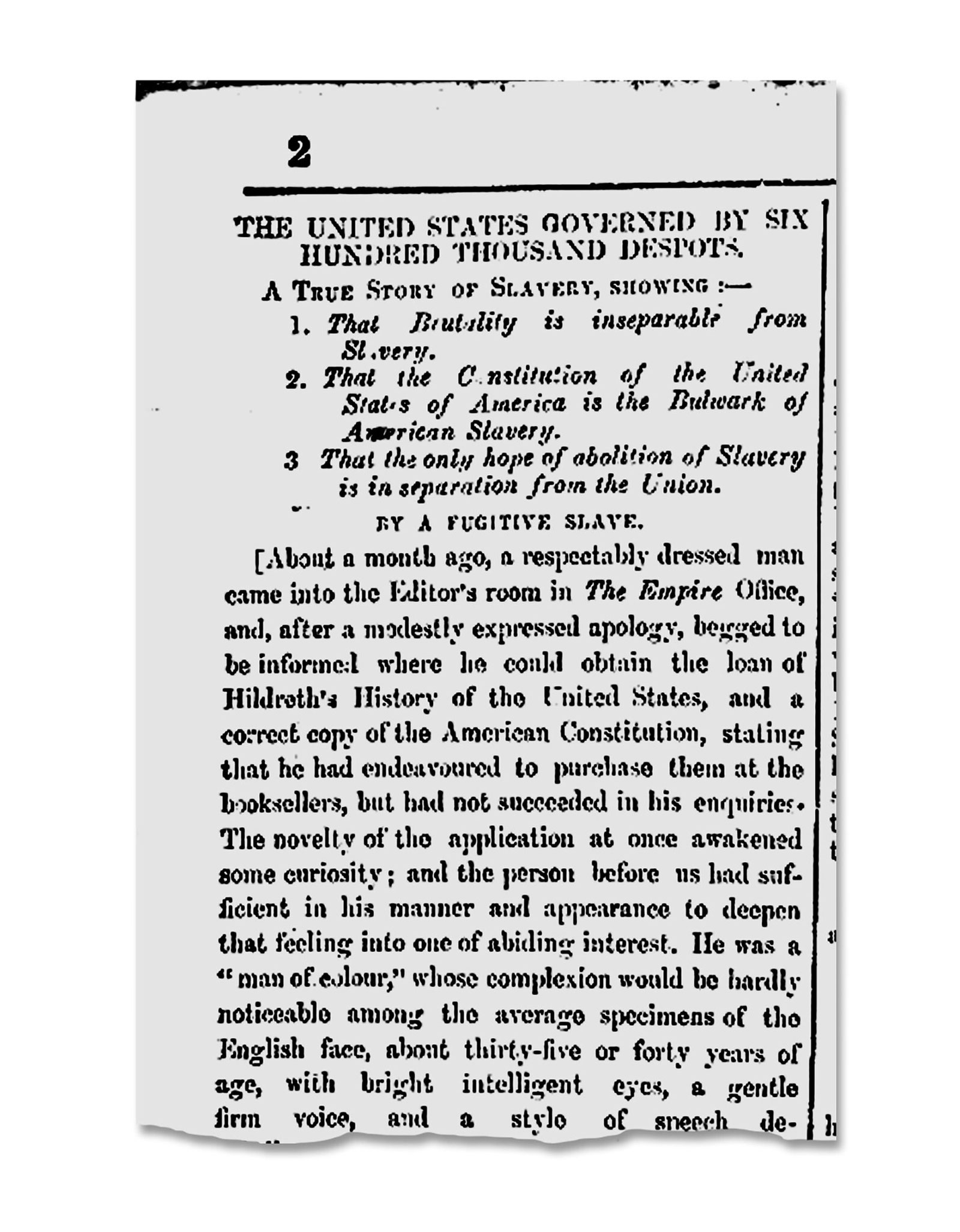
Literary scholar Jonathan D. S. Schroeder made a discovery of a lifetime earlier this year when he unintentionally found a lost slave narrative while searching in an online newspaper database.
The narrative written nearly 170 years ago is an autobiography by John Swanson Jacobs, the brother to famous ex-slave and abolitionist Harriet Jacobs. Harrient Jacobs also authored the 1861 autobiography “Incidents in the Life of a Slave Girl”.
The narrative boldy titled “The United States Governed by Six Hundred Thousand Despots” was originally published anonymously in two installments in Sydney, Australia. The book has now been edited and republished by Schroeder.
The aspect of this discovery and narrative that I found most compelling was the rawness of it all. Most slave narratives were heavy handedly edited by white abolitionists and thus heavily censored. For the almost 20,000 word text to remain largely unchanged is remarkable.
Jacobs’ harsh criticism of American liberty and democracy give such an important and real insight to the lives, thoughts, and feelings of the enslaved. Among these criticisms was a striking quote where he refers to the Constitution as a “devil in sheepskin”.
Constitution allowed for and protected an atrocity such as slavery for centuries, while ironically preaching ideas of freedom and equality and condeming the opressive government they revolted against; a true devil in sheepskin indeed.
Jacobs’ narrative and story is also unique in the fact that he spends much of his life outside of the United States. Much of his critisisms stem from his ability to compare his treatment in America to a much better lived experience as a black man in other countries. His experience perpetutes an often uncomfortable fact for many Americans: our land of equality and freedom doesnt even extend to the very people who built it, and other countries simply do the “American” ideas of liberty much better.
His time travelling the world also forces us to check ourselves on the single slave narrative we often think of. Jacobs’ life is a direct challenge on our limited understanding of our history. His story resurfacing now broadens our perspective and re-writes the history of slave narratives forever.
This incredible discovery makes me wonder what other narratives have been lost out there, but may still have a chance of being rediscovered.
I actually had the incredible honor of meeting Mr. Schroeder himself when he came and gave a talk at my high school in early November, and hear his first had account of his experience. If you are interested in reading more about the actual process of his discovery I’d highly recommend reading the New York Times article on the subject.
 Anthro Log
Leave a comment